

Appearance
Engaging organisations
Engaging organisations through services is a balance between a commercial process and an organisation's operating context: the services proposals pipeline and the organisation/provider lifecycle. Successful service engagement helps both parties understand the work, confirm capability, agree responsibilities, and move into delivery with the right information in place.
note
This page is specific to engaging organisations for services compared with a general approach to opportunities and the employment-focused Recruiting people model.
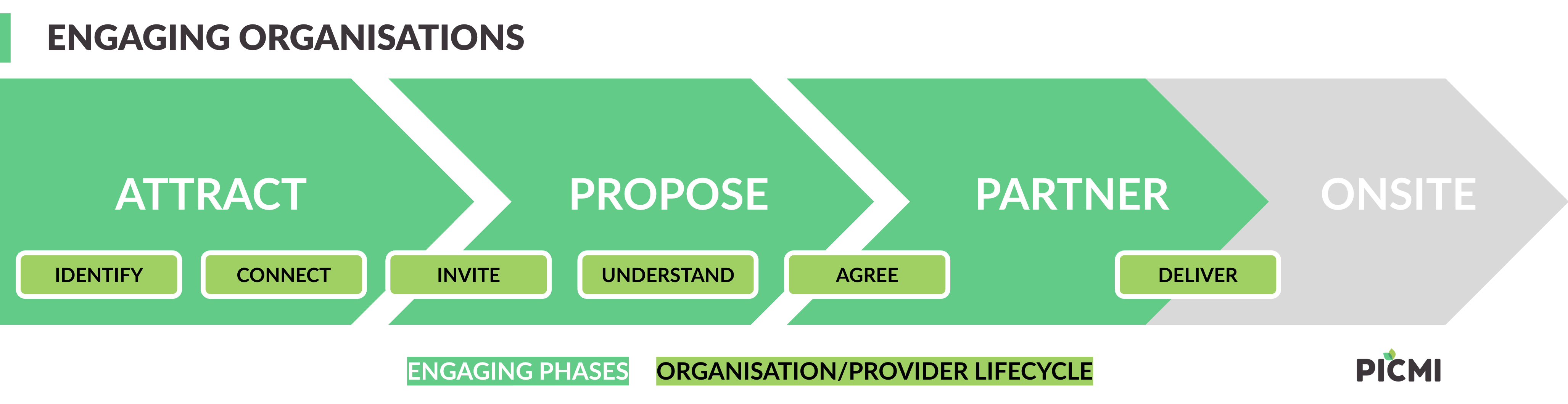
Three-stage model of service engagements
PICMI helps services engagement by breaking the process into clear stages. Instead of treating a services agreement as a single document to complete at the end, PICMI lets organisations collect the right details, review requirements, and confirm agreement through a structured workflow.
For services, the participant may be a grower, host, provider, contractor, employer, or another organisation. The same model works when one organisation is requesting services and another organisation is supplying them.
Services Pipeline
PICMI views engaging organisations as three primary phases before active service delivery: Attract, Propose, Partner and Deliver. PICMI focuses on streamlining the propose step and how it connects with the work that happens before and after.
Attract
This is about finding and selecting the right organisations to work with. A service opportunity may start through an existing relationship, industry network, direct invite, seasonal planning process, or a formal proposal.
PICMI does not force a single sourcing method. Organisations can use the channels that already work for their industry, then use PICMI once they need a structured way to capture information, compare requirements, and move toward agreement.
Propose
This is where PICMI is strongest. The engage phase turns an informal service need into a structured participation process.
During engagement, organisations can:
- explain the service being requested or offered
- collect operational details such as sites, blocks, service types, timing, and contacts
- gather compliance information such as certifications, declarations, policies, and documents
- review provider capability and service requirements before agreement
- issue or complete a services agreement once the required criteria are met
The goal is to reduce ambiguity. Each party should understand what is being provided, where it will happen, who is responsible, and what conditions apply before service delivery begins.
Partner
This is the phase where the agreed service moves toward operational delivery. PICMI does not replace the systems used to manage day-to-day work, scheduling, supervision, invoicing, or delivery reporting.
Instead, PICMI provides the agreed engagement record: the service details, declarations, documents, workflow responses, and signed agreement that other operational processes can rely on.
Onsite
This is the phase where the agreed service is in operational delivery.
Organisation/Provider lifecycle
The organisation lifecycle describes how two or more organisations move from initial contact to an agreed service engagement. The stages are similar to recruiting people, but the focus is on organisational fit, capability, responsibility, and service scope.
Identify
Identify the organisations that may participate in the service engagement. This may include growers, hosts, providers, contractors, employers, subcontractors, or programme partners.
Accurate organisation details matter because they flow into workflows, agreements, reporting, and compliance records.
Connect
Share enough information for each organisation to understand the opportunity and decide whether to continue. This may include service expectations, location details, seasonal timing, operational constraints, and the process for completing requirements.
Good engagement reduces back-and-forth by making the service context clear before detailed agreement work begins.
Invite
Invite the relevant organisation to complete the service workflow. This can be direct and targeted when the relationship is known, or part of a broader intake process when multiple organisations may be considered.
The invite gives the organisation a clear next step and connects them to the information they need to provide.
Understand
Both parties use the workflow to clarify fit and responsibilities. This may include confirming site details, services required, certifications, pay or charge structures, health and safety documents, subcontractor details, and other operational requirements.
The purpose is not just data collection. It is to make sure the agreement reflects the real service arrangement.
Agree
Once required information is complete, the parties review and sign the relevant services agreement or participation terms. Agreement details can be built from organisation data, opportunity data, workflow responses, and any engagement specific overrides.
The agreement should make the service scope, responsibilities, and conditions explicit before delivery starts.
Deliver
After agreement, the organisations move into active service delivery. The PICMI record remains the source of the agreed terms and supporting information, while operational systems and teams manage the work itself.